
What Is Artificial Intelligence in Gaming? Explained
Rahul Gurjar
What Is Artificial Intelligence in Gaming?
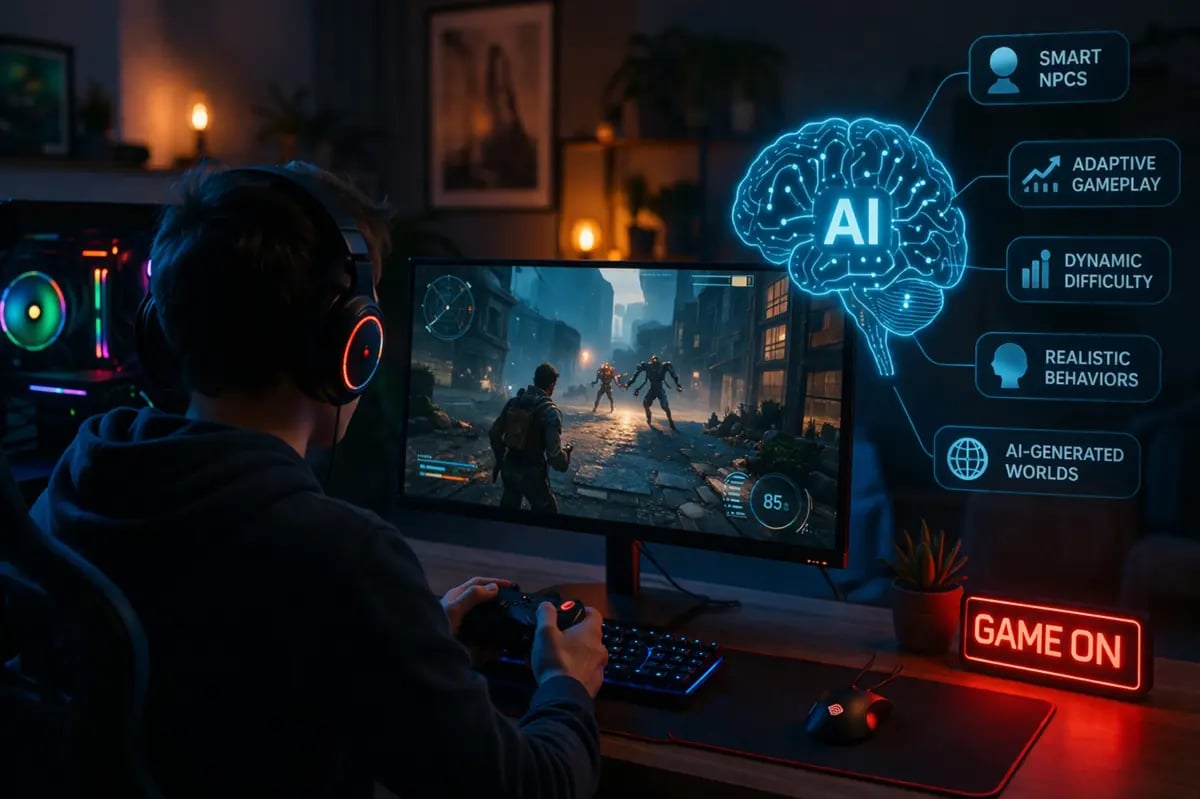
Artificial intelligence technologies can make a game a lot better. They make the game smarter and more fun to play. This is what people call intelligence in gaming. Artificial intelligence has become very important for making games today. It is used to create games that are intelligent, realistic, and filled with large open worlds.
Nowadays, artificial intelligence is used in almost every modern game. It makes games more interesting, more engaging, and more exciting for players.
Earlier, playing games was mostly about following fixed rules. Now, games are completely different. Games can change based on what the player does, create new experiences, and feel more interactive than ever. This is possible because of technologies like machine learning and neural networks. These technologies make games extremely smart. Games can now create content on their own, adapt to players, and feel more alive.
Artificial intelligence in gaming is not just a temporary trend. It is actually defining the future of the gaming industry and will continue to have a huge impact on how games are made and played.
A Short History of Artificial Intelligence in Games
Artificial intelligence in gaming is not new. It has existed for decades and has constantly evolved over time. Developers have been using AI techniques in games for many years.
Early Examples of Gaming AI
Pac-Man (1980): The ghosts used simple AI patterns, with each ghost behaving differently.
Chess Games (1990s): These games used rule-based reasoning systems to make decisions.
F.E.A.R. (2005): This game introduced advanced enemy AI that worked well with cover systems and teamwork, making enemies feel intelligent.
These early games relied on scripted artificial intelligence, where Non-Playable Characters (NPCs) followed pre-written instructions. While impressive at the time, these NPCs were not flexible and could not adapt to players.
How AI Works in Modern Gaming
Modern gaming AI uses multiple technologies working together, such as:
Machine learning
Computer vision
Natural language processing
Decision systems
These technologies are the reason why modern games feel so realistic, responsive, and immersive.
Machine Learning in Gaming
Machine learning systems observe player actions and improve their behaviour over time.
A famous real-world example is DeepMind’s AlphaGo, which defeated world champion Lee Sedol in 2016. While AlphaGo was not a video game, it proved that AI can learn complex strategies.
This same concept is now used in video games to create intelligent NPCs that adapt, learn, and challenge players in smarter ways.
Decision Systems & Behavior Trees
These systems determine how NPCs react in real time.
In The Last of Us Part II, enemies:
Communicate with each other
Sneak up on players
React emotionally when allies die
These behaviours are powered by advanced AI decision systems, making enemies feel more human and realistic.
Procedural Content Generation (PCG)
With procedural content generation, AI creates:
Levels
Missions
Worlds
A great example is No Man’s Sky, where AI generates billions of unique planets, creatures, and ecosystems. This makes every player’s experience different and unpredictable.
Applications of AI in Games
Artificial intelligence is changing both how games are developed and how they are played.
AI in Non-Playable Characters (NPCs)
Modern NPCs can:
Learn player strategies
React dynamically
Adjust difficulty levels
In Middle-earth: Shadow of Mordor, the famous Nemesis System remembers player encounters. If an enemy defeats the player, it becomes stronger and remembers that battle. This system is considered one of the biggest AI innovations in gaming history.
AI in Game Testing
AI bots now test games faster than humans.
Real-world example:
Ubisoft uses AI to automatically test:
Game environments
Bugs
Game balance
This allows games to be developed more efficiently and with fewer errors.
Artificial Intelligence in Real-World Games
GTA V & Rockstar Games
Rockstar Games uses AI to control:
Pedestrian behaviour
Traffic systems
Police responses
NPCs in GTA V follow routines, react to crimes, and respond differently to player actions.
For GTA VI, Rockstar is expected to push AI even further by introducing emotion-based NPCs and memory systems, making characters feel more realistic.
Red Dead Redemption 2
RDR2 is one of the best examples of AI in gaming:
NPCs remember past interactions
Animals behave naturally
Towns evolve over time
This realism was praised by critics and players worldwide.
AI in Competitive Games
AI has also been tested in competitive games like Dota 2 and StarCraft II.
In 2019, OpenAI Five defeated professional Dota 2 players, proving that AI can handle team-based strategy games at the highest level.
AI and Player Experience
Artificial intelligence significantly improves the player experience.
Dynamic Difficulty Adjustment
AI adjusts difficulty based on player performance.
For example, Resident Evil 4 Remake uses AI to make enemies stronger or weaker depending on how well the player is doing. This keeps the game challenging but fair.
Personalized Gameplay
AI tracks:
Player choices
Playstyle
Preferences
This allows games to offer personalized missions, rewards, and challenges.
AI in Open-World Games
AI is especially powerful in open-world games.
Smarter Worlds
AI controls:
Weather systems
Wildlife behavior
NPC schedules
In Assassin’s Creed Odyssey, NPCs work, sleep, and travel, making the world feel alive and dynamic.
AI-Powered Game Design Tools
Developers now use AI for:
Character animation
Voice generation
Environment design
In 2023, NVIDIA showcased AI-driven NPCs capable of real-time conversations, which could completely change storytelling in future games.
Ethical Issues and Limitations of AI in Games
Despite its benefits, AI has challenges:
Predictability vs Fairness: Overpowered AI can frustrate players.
Data Privacy: AI collects player behavior data.
Development Cost: Advanced AI increases development time, contributing to delays in games like GTA VI and The Elder Scrolls VI.
Future of AI in Gaming
The future of gaming AI is revolutionary.
What to Expect
Fully conversational NPCs
AI-generated storylines
Emotionally reactive characters
Real-time evolving worlds
Experts believe AI will make games feel more like living realities than scripted experiences.
AI in the Gaming Industry Growth
The AI gaming market is growing rapidly due to:
Cloud gaming
Metaverse development
VR and AR integration
Companies like Sony, Microsoft, and Tencent are heavily investing in AI-driven gaming technologies.
Conclusion: The Importance of AI in Gaming
Artificial intelligence in gaming is transforming video games into smart, adaptive, and immersive experiences. From realistic NPCs to evolving worlds, AI is redefining how games are made and played.
Real-world examples like AlphaGo, OpenAI Five, and Rockstar’s AI systems show that AI is not the future—it is already here.
As technology continues to improve, AI will blur the line between virtual and real worlds, making gaming more engaging than ever before.